What Is Original, Traditional Thai Massage? A Quick Guide

Key Takeaways

  • Traditional Thai massage has a documented history going back more than 2,500 years, rooted in Ayurvedic medicine and Buddhist tradition
  • It is performed on a floor mat, fully clothed, without oils, using pressure along energy lines combined with assisted stretching
  • UNESCO inscribed Nuad Thai on its Representative List of the Intangible Cultural Heritage of Humanity in 2019
  • Many spas blend Thai techniques with table massage and oils, which is relaxing but is not authentic Thai massage
  • The practice was designed as a complete wellness system, not a treatment for one specific condition
  • Office workers and people of all ages can benefit, no injury or prior experience required

Table of Contents

  • The Origins of Traditional Thai Massage
  • What Makes It Different From Other Massage Styles
  • How Authentic Thai Massage Differs From Westernized Versions
  • Who It Is Actually For
  • Experience Traditional Thai Massage at Refresh Thai Spa

The Roots of the Original, Traditional Thai Massage

Not all massages called "Thai" are the same. The original traditional Thai massage has a documented history, a distinct technique, and a philosophy behind it that sets it apart from what many spas offer today. Knowing the difference matters, especially if you want the actual benefits the practice was designed to deliver. Here is what authentic Thai massage is, where it came from, and why the original technique still holds up after more than two millennia.

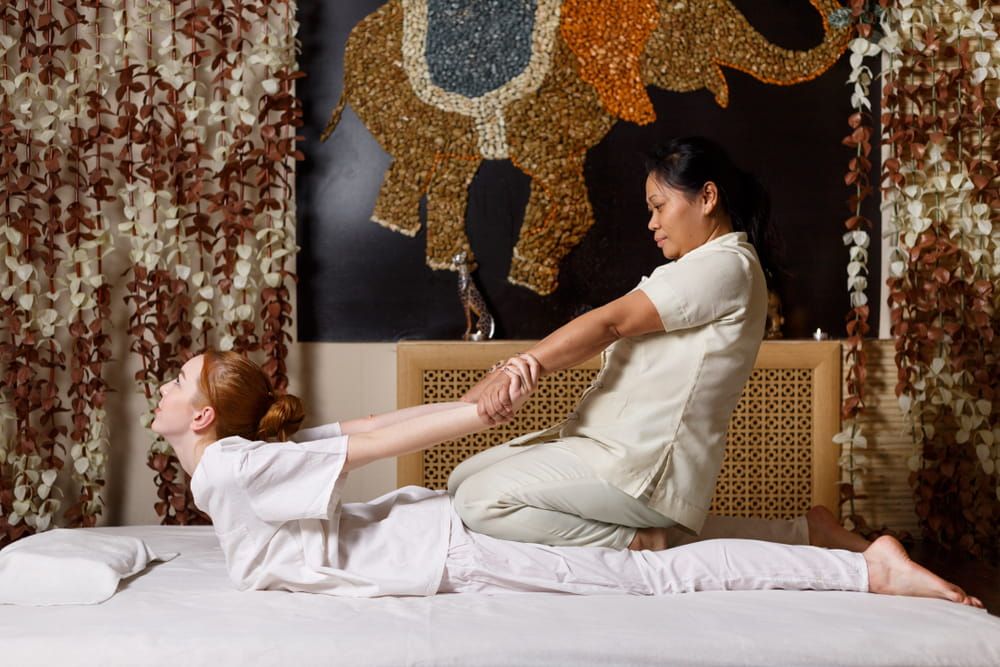
A woman receiving a traditional Thai massage with assisted stretching from a licensed therapist

The Origins of Traditional Thai Massage

The history of Thai massage traces back over 2,500 years, with roots in Ayurvedic medicine and Buddhist tradition rather than in Thailand itself. The practice is traditionally credited to a physician named Jivaka Kumar Bhaccha, also known in Thailand as Shivago Komarpaj. He was a contemporary of the Buddha and the personal physician to the Magadha King Bimbisara in northern India. His teachings are believed to have reached what is now Thailand around the same time as Buddhism, in roughly the 2nd or 3rd century BCE.

From there, the practice was preserved and passed down within Buddhist temples, most notably Wat Pho in Bangkok, which is still considered the leading center of Thai massage education today. For centuries, knowledge was transmitted orally from master to student and treated as both a healing art and a spiritual discipline. The depth of that history is part of why UNESCO formally inscribed Nuad Thai, traditional Thai massage, on its Representative List of the Intangible Cultural Heritage of Humanity in 2019, recognizing it as a living cultural practice with global significance.

What Makes It Different From Other Massage Styles

A simple traditional Thai massage definition comes down to this: it is a fully clothed, oil-free practice performed on a floor mat that combines rhythmic pressure along the body's energy lines with assisted stretching. That alone separates it from almost every other massage style most people are familiar with.

In a typical Swedish or deep tissue session, the client lies on a raised table, undresses to their comfort level, and the therapist works with oils and long flowing strokes. Thai massage looks completely different. The therapist uses hands, thumbs, elbows, knees, and even feet, moving through a structured head-to-foot sequence and guiding the client into yoga-like stretches throughout the session. It is sometimes described as "lazy man's yoga" because the body is moved and opened by the therapist rather than by the client's own effort. The result is something that feels both deeply relaxing and physically active at the same time, which is rare among bodywork styles.

How Authentic Thai Massage Differs From Westernized Versions

As Thai massage spread globally, many adaptations emerged. Some spas blend Thai techniques with table massage, oils, or Swedish strokes, while others apply the "Thai" label loosely to any session that involves stretching. These hybrid styles can certainly be relaxing, but they are not the original, traditional Thai massage as it was developed and preserved over centuries.

Authentic Thai massage has several specific markers that are easy to recognize once you know what to look for. The session is performed on a floor mat rather than a raised table. The client stays fully clothed, usually in loose, comfortable clothing. No oil is used. The therapist follows a structured sequence rather than a freeform routine, working systematically from the feet upward or the head downward. And the technique uses the therapist's full body, including hands, thumbs, elbows, knees, and feet, to apply pressure and guide stretches. If a session you book misses most of those markers, it may be a relaxing massage, but it is not traditional in the historical sense.

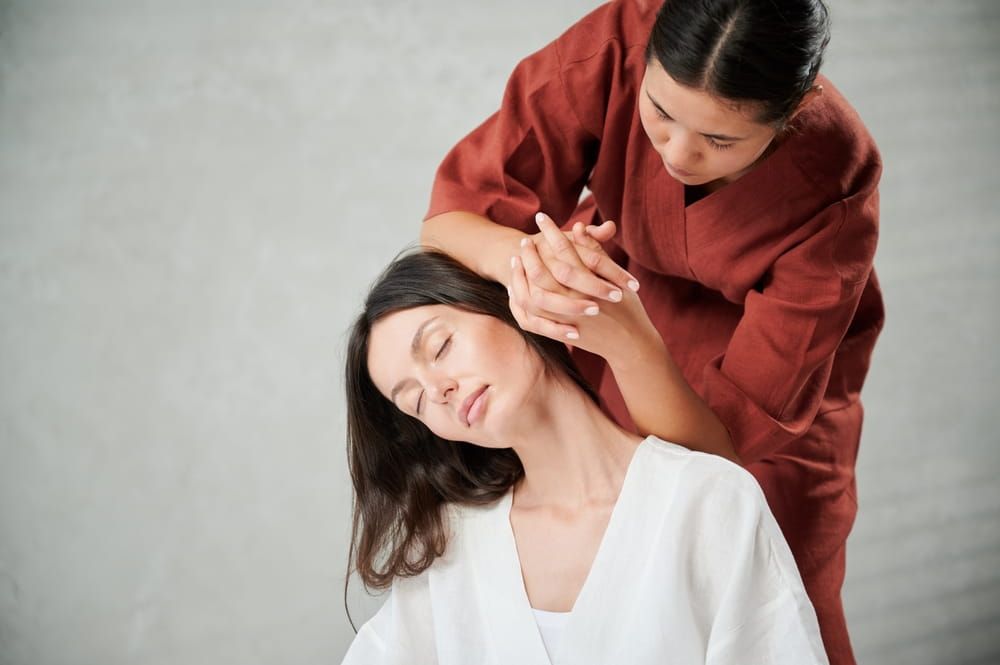
A woman with eased shoulder tension following an authentic Thai massage

Who It Is Actually For

One thing that often gets lost in modern spa marketing is that traditional Thai massage was never designed as a treatment for a single, specific problem. It was developed as a complete wellness practice, meant to support the body and mind together rather than to fix one isolated complaint.

That makes it well suited for office workers carrying tension from long hours at a desk, the kind of stiffness that builds up across the shoulders, neck, hips, and lower back over a five-day work week. It also suits anyone who wants a full head-to-foot reset rather than a session focused on one problem area. You do not need an injury, chronic pain, or an established wellness routine to book one. The practice is appropriate across a wide age range, from busy professionals in their late 20s to retirees in their 60s and beyond, and most people find that a single session leaves them noticeably looser, calmer, and sleeping better that night.

Experience Traditional Thai Massage at Refresh Thai Spa

The history behind traditional Thai massage is not just interesting context, it is the reason the technique works the way it does. Centuries of refinement inside Buddhist temples produced a structured, full-body practice that holds up because it was built to address how the human body actually carries tension. At Refresh Thai Spa in Plano and Richardson, TX, our licensed therapists are trained in authentic Thai methods rooted in the original practice, including Nuad Boran, the classical form of Thai massage. Sessions are performed in a private, calm setting and personalized to your needs.

Experience traditional Thai massage the way it was meant to be practiced. Book your session today at Refresh Thai Spa.


References:

Nuad Thai, traditional Thai massage. Retrieved on April 29, 2026 from https://ich.unesco.org/en/RL/nuad-thai-traditional-thai-massage-01384

Traditional Thai massage is listed as a UNESCO intangible cultural heritage. Retrieved on April 29, 2026 fromhttps://www.tatnews.org/2019/12/traditional-thai-massage-listed-as-an-unesco-intangible-cultural-heritage/


Frequently Asked Questions About Traditional Thai Massage

Q: Why is Thai massage famous?

A: Thai massage is famous for its unique combination of acupressure, assisted stretching, and rhythmic full-body work, performed fully clothed on a floor mat without oils. It carries more than 2,500 years of documented history rooted in Ayurvedic medicine and Buddhist tradition, and in 2019 UNESCO formally listed it as part of the Intangible Cultural Heritage of Humanity.

Q: What is the simple definition of traditional Thai massage? 

A: Traditional Thai massage is a structured, full-body practice performed on a floor mat with the client fully clothed. The therapist uses hands, thumbs, elbows, knees, and feet to apply pressure along the body's energy lines and guide assisted stretches. No oils are used, and the session follows a head-to-foot sequence rooted in centuries of practice.

Q: How can I tell if a Thai massage is authentic? 

A: An authentic Thai massage is performed on a floor mat, with the client fully clothed and no oils involved. The therapist uses a structured sequence rather than a freeform routine, and incorporates assisted stretches throughout. If the session takes place on a raised table with oils and long flowing strokes, it is likely a hybrid style rather than traditional.

Q: Do I need to be flexible to receive a traditional Thai massage? 

A: No. The therapist guides the stretches based on what your body can comfortably do, which is part of why the practice is sometimes called "lazy man's yoga." It works for a wide range of ages and fitness levels, and the pressure can be adjusted to your preference.